

Can you clean your own air ducts? Sure, to a point. The real question is whether that’s enough for what your home needs, which is what an air duct cleaning company like ours gets asked constantly. As a NADCA-certified team, we wanted to break this down honestly rather than just tell you to call us.
- DIY tools reach roughly the first two feet of ductwork behind each vent
- Professional cleaning reaches the full system using negative pressure, including the bends and trunk lines DIY can’t touch
- DIY is fine for light surface maintenance; it’s not built for mold, pests, or years of built-up buildup
- Professional cleaning costs more upfront but covers the whole system and includes an inspection
Why Charleston changes the answer
Charleston homes push more of this job out of DIY range than homes in a dry climate do.
Most houses here run ductwork through crawl spaces or unconditioned attics rather than through interior walls. Those are the sections that collect the most and are the hardest to reach, and they sit on the far side of every bend a vacuum hose cannot turn.
The humidity matters more than the dust. Charleston averages high relative humidity year round, and duct systems in the Lowcountry accumulate moisture-related problems as often as dirt: condensation on cold supply lines, damp insulation on crawl space runs, and mold growth on registers in rooms that stay closed. Vacuuming does nothing to a moisture problem. It removes what you can see and leaves the cause running.
What DIY Duct Cleaning Covers
DIY duct cleaning covers the vent covers, the registers, and the short section of duct you can see and reach behind each one. Done every few months, it is worthwhile upkeep.
- Turn the HVAC system off at the breaker before you start.
- Remove the vent covers with a screwdriver.
- Vacuum the visible ductwork just inside each opening, about the first two feet.
- Wipe the covers with a damp microfiber cloth. Let them dry fully before reattaching.
- Replace the air filter on schedule. This does more for long-term duct cleanliness than the other four steps combined.
Tools: a vacuum with a hose attachment, a soft-bristled brush, microfiber cloths, a screwdriver, and a dust mask and gloves.
A hardware store vacuum loses useful suction past roughly two feet inside a duct. That limit is the reason for everything in the next section.
What Professional Duct Cleaning Covers
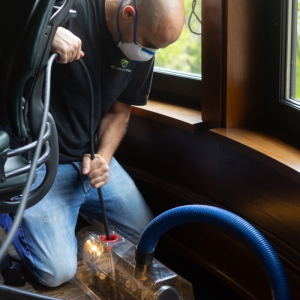
Instead of pushing a hose in from the vent, here’s how we actually work through your system:
- We connect to the main trunk line, not just the vent. This creates negative pressure that pulls air, and everything in it, through the entire duct system rather than just the first couple feet.
- We clean the full length of ductwork. That includes bends, attic runs, and crawl space sections that a handheld vacuum simply can’t reach.
- We clean registers, grilles, and the blower compartment too. Leftover dust in these spots can recontaminate freshly cleaned ductwork within weeks if they’re skipped.
- We inspect before and after. This catches issues like leaks, disconnected sections, or signs of moisture early, and gives you a chance to see the results once we’re done.
That’s the mechanical difference a hardware store vacuum can’t replicate: real negative pressure across the whole system, not just suction at the opening.
DIY Vs. Professional Duct Cleaning: How to Tell Which One Your Home Needs
If you’re just seeing some dust on the vent covers and nothing else stands out, DIY maintenance is a reasonable choice. If any of the following sound familiar, it’s time to bring in a professional instead:
| What You’re Noticing | DIY or Professional |
| Light dust on vent covers, nothing else | DIY is fine |
| Musty smell near vents | Professional (possible mold) |
| Droppings, nesting material, or pest odors | Professional |
| Energy bills rising with no clear cause | Professional |
| Ducts haven’t been touched in 5+ years | Professional |
| Someone in the home has asthma or severe allergies | Professional |
| Visible mold on vent covers or registers | Professional, testing first |
If your situation lines up with the professional column, that’s less about DIY tools failing you and more about the problem needing equipment and expertise that goes beyond what’s available at a hardware store.
What goes wrong when DIY goes too far
Three things break when tools get pushed past the accessible section of duct.
Flexible duct tears. Flex duct is a thin liner over a wire coil. A stiff brush pushed into it punctures the liner, and the tear is inside the wall or crawl space where you will not see it.
Joints work loose. Repeated pressure from a vacuum hose at a seam separates the connection over time. A separated joint dumps conditioned air into a crawl space, which costs more than a cleaning would have.
Debris moves the wrong way. Without negative pressure holding the system, scrubbing pushes contaminants deeper into the ductwork rather than pulling them out. The vent looks cleaner and the system is dirtier.
None of this happens if you stay with the five steps above. It happens when the brush goes past arm’s reach.
Talk to Us Before You Decide
If you’re not sure which side of this your home falls on, that’s a fair thing to ask us before you spend money either way. We’ll take an honest look and tell you what we’d actually recommend, not just try to book a cleaning you don’t need.
Reach out and we’ll help you figure it out.

Frequently Asked Questions
What does DIY duct cleaning cost compared to professional cleaning?
DIY runs about $50 to $150 in supplies, mostly a vacuum attachment, a brush, and some cloths. Professional cleaning runs anywhere from $250 to $950 or more, depending on your home’s size, how many vents you have, and how much buildup we’re dealing with. The gap in price reflects the gap in coverage: DIY typically reaches around 25 to 30 percent of your duct system, while a professional cleaning reaches the whole thing, including everything DIY tools can’t get to.
If I find mold, does that change things?
Yes, and it’s worth treating separately from a standard cleaning decision. Disturbing mold without proper containment can spread spores rather than remove them. Certified mold inspection services in Charleston, SC confirm what’s actually there, and professional mold remediation handles removal separately once testing confirms it.
What tools do I need for basic DIY maintenance?
A vacuum with a hose attachment, a soft-bristled brush, microfiber cloths, a screwdriver for the vent covers, and a dust mask and gloves for your own comfort.
How often should a professional cleaning happen?
Most homes do fine with a full cleaning every one to three years. Pets, smokers in the household, recent construction, or known allergy sensitivities tend to shorten that window.
Can DIY cleaning actually damage my ductwork?
It can, though usually only if tools get pushed further than they’re meant to go. Flexible duct is the most vulnerable to tearing, and repeated pressure on joints can work connections loose. Sticking to the visible, accessible sections avoids most of this risk.
Does professional duct cleaning lower energy bills?
Sometimes, and not always by much. A duct system heavily restricted by debris makes the blower work harder, so clearing it helps. But the larger energy losses in Charleston homes usually come from leaks and disconnected joints in crawl space ductwork, which is a repair rather than a cleaning. The inspection is what tells you which one you have.
Is duct cleaning worth it with no symptoms at all?
Not on its own. If nothing on the decision table above applies, a schedule-based cleaning is a reasonable choice but not a requirement. Replacing the filter on time does more for a system with no other symptoms.
